
CZELO organised IGLO Open on the topic of Union of Skills
IGLO Open presented the Union of Skills and the Czech examples of innovations.
On November 19, 2025, the CZELO office at the Permanent Representation of the Czech Republic to the EU in Brussels organised an IGLO Open meeting dedicated to the European Union of Skills initiative. The event showed how European institutions, regional organisations, and universities can work together to respond to the skills shortage in Europe and the rapidly changing technological environment, which significantly shapes the labour market and the competitiveness of Member States. The meeting also offered two inspiring Czech examples of how European priorities can be translated into concrete actions.
The opening presentation was given by Dalibor Mladenka from the Directorate-General for Education, Youth, Sport and Culture (DG EAC). He presented the framework of the Union of Skills initiative and emphasised that Europe faces a long-term shortage of skilled workers, while education systems are struggling to respond to the needs of the modern economy. These are changing rapidly, particularly with the advent of digital, green, and deep-tech technologies. The European Commission is therefore focusing on strengthening cooperation between universities and businesses, developing educational tools, and supporting experts in technologically strategic fields. The main elements of this approach include expanding the EIT Campus platform, developing the Deep Tech Talent initiative, supporting European Skills Academies, and strengthening the innovation capacity of universities through the EIT HEI Initiative program. As Dalibor Mladenka stated, the ambition of the Union of Skills is not only to address the acute shortage of experts, but above all to increase Europe's competitiveness and its ability to adapt to emerging technological trends in the long term.
This was followed by a presentation by Adéla Hradilová from the Moravian-Silesian Innovation Centre, which focused on the ongoing transformation of the Moravian-Silesian Region. For decades, the region was primarily associated with heavy industry, but today it is gradually transforming into a dynamic innovation environment. Adéla Hradilová presented several areas in which MSIC supports entrepreneurship and innovation, from the development of startups and scaleups to the internationalisation of small and medium-sized companies to systematic work with talent, mentoring, boot camps, and strengthening cooperation between universities and companies. Special attention has long been paid to young people. Programs such as LabZero and Startovárna help develop their entrepreneurial thinking, work with their strengths, and discover paths to regional companies. These activities aim to attract more talent to the region, strengthen technology transfer, and, in the long term, create an environment in which new scaleups and ambitious technology companies can emerge.
The last speaker was Professor Andrew David Miller from Mendel University, who presented the InnovPrecMed project focused on the development of precision medicine and deep-tech innovations. The project was created as part of the EIT HEI initiative and connects university teams, researchers, businesses, and start-ups. Professor Andrew David Miller described how a modern university should fulfil three equally important tasks: high-quality teaching, cutting-edge research, and an active role in innovation. InnovPrecMed therefore focuses on the development of personalised diagnostics, new therapeutic approaches, and technologies for drug delivery, for example, through lipid nanoparticles. The project also includes the preparation of new educational programs, mentoring of researchers and students, the establishment of deep-tech spin-offs, and the strengthening of technology transfer. The goal is to build an internationally competitive environment that will support the development of precision medicine throughout Central and Eastern Europe.
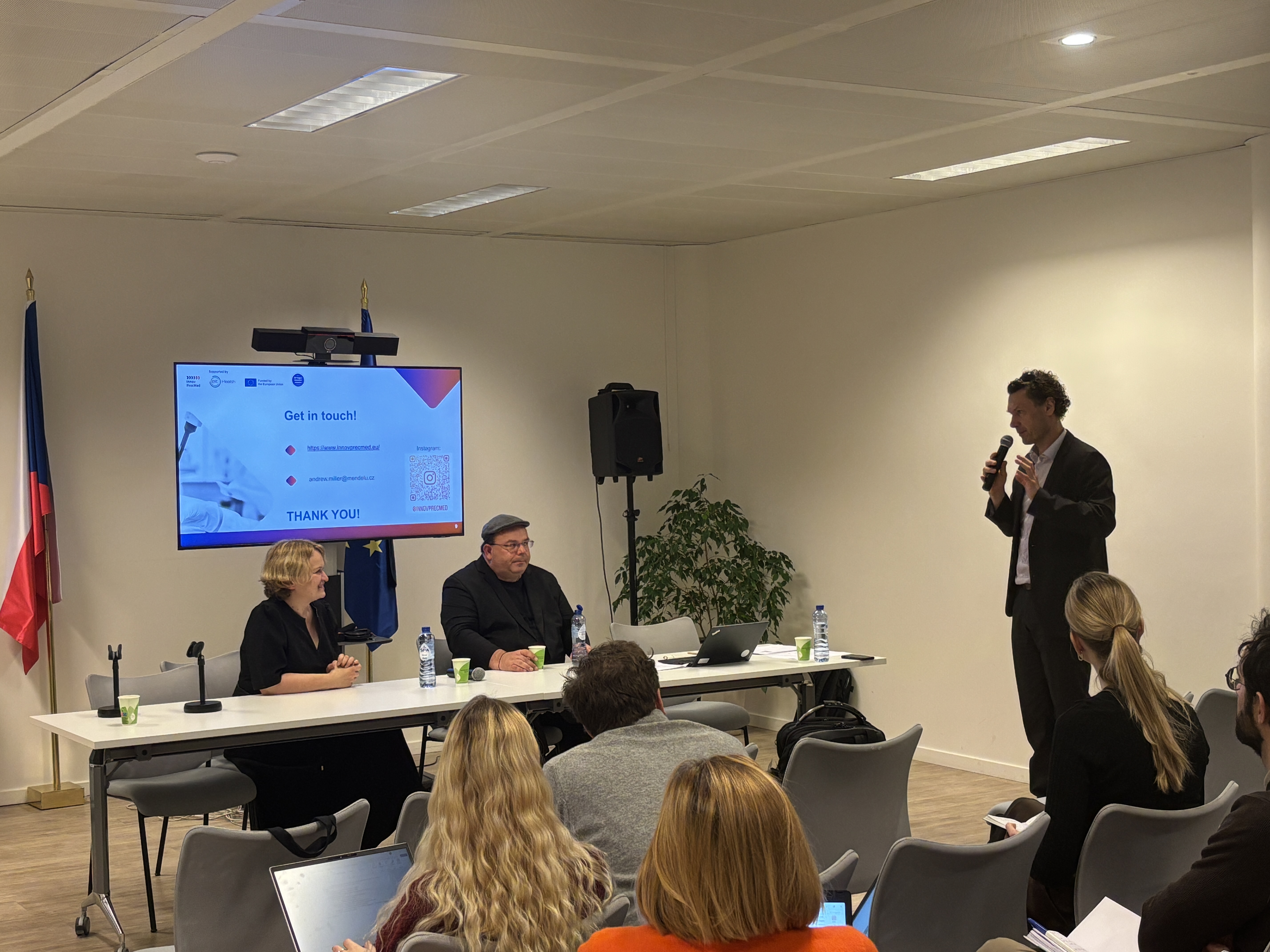
The final discussion focused on how to overcome cultural barriers that often slow down innovation processes at universities and public institutions. Participants agreed that funding alone is not enough. Equally important are universities' openness to entrepreneurship, more flexible treatment of intellectual property, strengthening of technology transfer offices, greater willingness to take risks and accept failure as a natural part of the innovation process, and more intensive cooperation between academia, businesses, and regional actors. The discussion also showed that the Czech Republic has projects that can significantly contribute to European priorities in the area of skills development and support for technological transformation.
The minutes of the event are available on the CZELO website.